Making a difference – MHFA at Leeds Mencap

dsc_2573_22389755988_oIt dawned on me with some surprise that I’ve been an MHFA trainer for over two years now – I’ve run around 18 courses I think, in Leeds, London, Burnley. I’ve had three different co-trainers, and also run some sessions alone.  Varying sized groups, each one different and with its own unique discussions and lessons to learn. But all have been in the same context – within my “day-job” employer.

Mental health is one of the leading causes of sickness absence, and of disability related unemployment. A lack of understanding of mental health issues in employers can make life very difficult for those of us who are trying to stay in work while managing our conditions. So I do not underplay the value of delivering MHFA in the workplace. Absolutely not – I doubt I would have held on to my job at certain points in the past few years had my employer not accepted their duty to make reasonable adjustments, and my managers worked with me to find out what helped me to keep delivering as they expected.

However, it can’t be denied that it is somewhat of a “safe” environment. A) a lot of our staff have perhaps a higher level of awareness of health issues, as that is the area we work in, and B) – if you go for a course in your own workplace, you are still very much in a work mindset, there is probably a consciousness than anything you might say might get back to your manager – or indeed you might be sharing the room with others who you might work with. There will inevitably be some element of holding back.

So – it was with some nervousness, as well as excitement that I arrived at Mencap Leeds to deliver my first freelance MHFA course “in the wild” – or out in the community. I knew that it would be different, and I was keen to find out how.

My co-trainer Sam had done the hard work of organising and advertising, so all I had to do was turn up, set up and bring my training mojo.

We had a full room, 16 trainees, from a variety of organisations. An interesting mix – from a law firm, construction company, local council, recruitment, charities and individual participants. A good group from the local Nigerian community so some ethnic diversity, though sadly only one man in the group (it really would be nice to get more men along.)

There was some practical / logistical learning for Sam and I – the group was a bit more prone to discussions amongst themselves, and the use of workbooks meant they could see ahead of time some of the exercises which benefited from the element of surprise – so we will need to learn to be a bit more “teacherly” and keep things more under control in future.

We had some excellent discussions – it is always a challenge to fit all the content in and still have the chance to share some  of the thoughts and experiences we each bring to the session, but it is I think where a lot of the real learning and changing goes on. We had people with personal experience, and who developed new understanding about people in their lives.

One aspect that particularly stood out for people was the number of men who die through suicide. Some of you may have seen recent campaigns aimed at raising awareness of mental health issues in men – getting people to realise there is nothing unmanly or wrong about talking about your emotions, admitting you are having a hard time, asking for help. It is a huge problem – and one which is even more pronounced in cultures, or sections of society which have more exagerrated or strongly deliniated gender roles.

Of 6,233 suicides in the UK in 2013, 4,858 or nearly 78% were men. And if anything we know this is under-reporting. For a variety of reasons some suicides will end up being coded as misadventure, accident or other reasons. Suicide in general is a major public health issue – it kills many more people than die on our roads. Most people who take their own lives have not been in touch with mental health services in the year previously, which suggests there is a major opportunity to help prevent these deaths – if we can help people to feel able to admit they are struggling, and talk about things with friends – then hopefully we can help them to seek help, and find the hope they need to hold on.

We also discussed the challenges faced in trying to increase understanding in some cultures where mental health is viewed in a very different way. It is difficult to manage our own frustration, disagreement, even anger, when faced with someone who, for instance, might see mental health problems as a sign of possession by demons, or even evil – but simply shouting over or dismissing another person’s belief is unlikely to help anyone. Even in our own country and society there is plenty of stigma and misunderstanding, and many people who would rather turn their back on people with severe mental health problems, or view people as lazy or weak, than take the time to understand psychosis or appreciate the impact of depression and anxiety. It’s not long since the standard approach to someone who experienced extreme distress, or detatchment from reality was to lock them away and forget about them. We can hardly be surprised that there are places in the world where this still stands (or is perhaps the best someone can expect). Our job is to keep trying to educate, and help people to understand mental health as a normal spectrum of experience – how this can develop and also that it can be helped.

At some point in the afternoon I realised – or more accurately, remembered, the importance of the work we do. That it is bigger than ensuring your manager understands to help you manage your stress levels and gives you the adjustments you need (though these are important in their own way) – but actually at root, the reason I teach MHFA, and strive to raise awareness and understanding of Mental Health – is that this is a life or death issue.

I have been on the brink of death. Though it is many years since I did anything about it, I have wanted to die. And I am sure I would have taken that step had I not learned some of the things which keep me hopeful, which help me remember that the clouds will pass.  But I did get help, I continue to find ways of coping with life and the muddle of emotions that sweep me this way and that. I can even control them more than I ever thought possible. Helping more people to understand that this is not something someone pretends for fun, or attention, but a very real and painful illness – is so very important.

And as we help to keep people alive, we must also help them live, build lives, families, relationships, have jobs, dreams and desires. Because we all deserve to be happy and fulfilled, and I am confident that with the right support and understanding, we can.

If you’d like to come along and learn how you can help make a difference, we’re running another session in February – you can book on Eventbrite, here:

http://www.eventbrite.co.uk/e/mental-health-first-aid-standard-course-tickets-19277083275?aff=erelexpsim


All things to all men

MHFA logo

I keep saying to myself that I will do a bit of a reflective wash up after each course – to think about what I have learnt, what went well, what didn’t, what could be improved. So. Here I go.

I just ran a course on the 19th & 20th August – in my workplace. Slightly larger group than I have done before mostly, thanks to being able to get one of the larger “board” rooms which are usually occupied by branch meetings, large video conferences, or appearances by our senior management. Another thing that differed from usual was that it was two consecutive days. Feedback in the past has been that people find it hard enough to get one day away from the office in a week, let alone two – but August is a quieter month for some, and as my co-trainer was travelling from London it was more convenient for them to do it in one chunk.  After all, that is how the course is designed to be delivered – though it does feel quite intensive, and very tiring.

So – logistics wise. The room itself was a bit strange. It is large – the left hand side of the room has a big screen, which had rows of chairs laid out infront, theatre style – (and a smaller screen behind them); the right hand side of the room has a large board room set up, table with chairs around.  This presented a bit of a dilemma, as we needed trainees to see the screen for the presentations and videos, but the table area was more appropriate for group exercises, and general discussions. I initially intended to stick with the theatre arrangement, and move over to the tables for the exercises, but I could tell it wasn’t really working. People weren’t talking to eachother as much as usual, they were a bit closed off, – and not surprising as they were sat with their backs to others. So we decided to switch things around at lunchtime, and moved the tables over so people sat around – but could still see the screen.

We (the trainers) were happier with this. The group did seem to open up and gel a bit more then. However the table layout was mentioned negatively in some feedback, as it meant looking at the screen side on. I guess you can’t please them all – everyone has their own preferences. I still think I would do the same, as I don’t think we would have got the same development in the room had we stayed in neat little rows.

The room was relatively well air conditioned – with opening windows (like hens teeth in our building) – which again, was great for the trainers, who were overheating, but some people found it cold. On balance, having been in overpopulated tiny rooms that turn into saunas – I think it preferable, but I wonder is there a middle ground to be had anywhere in the building. All of the rooms make you feel like Goldilocks – this one is too hot, this one too cold, this one is too small, this one too big…  We can only work with the resources we have.

I had been a little concerned about the slightly larger group, wondering if I woud be able to keep control, if discussions would go on longer than we had time for, etc. but it was alright. In the end we still had three spaces below maximum, and it worked pretty well. Had there been more “talkative” attendees it might have been different but there was a balance really of the quieter and the “loquacious”.

Content wise – I will be honest and say it wasn’t my most successful session. We still got good feedback, but sometimes I come away feeling like people have really benefited / enjoyed / learned / bonded. Not so much this time. And I think it comes back to the issue of trying to be all things to all men. The people there were wanting quite different things, I think – some of them got what they were looking for, some of them maybe didn’t.

What is the course for, after all? We aim to raise awareness of mental health issues, challenge stigma, educate about symptoms and treatment, and give people some skills to use in offering first aid for people in mental health crisis situations. There is applicability in a work setting, and it is discussed, but it is a very holistic view. What you get out of it comes down to a number of factors – what is your level of understanding about mental health when you come in, what are your expectations, and can you empathise with what you are being shown? Everyone has different learning styles, so there are different kinds of content: statistics, images, video, group exercises, personal reflection. Different people in the same group will find different aspects more or less useful. Personal anecdotes and background discussion add depth to the content – but sometimes people want more.

The course is very recovery focussed, because that is the most important message. It is about giving people with Mental Health issues hope – because for the vast majority, recovery is possible, with the correct treatment and/or support. It is also about letting everyone know that recovery is possible, and that consigning people with Mental Health problems to the rubbish heap of life is not only wrong on a personal and moral level, but also a massive waste. Friends and family need to know that they can play an enormous role in helping someone recover, employers need to know that if they support a member of staff with mental health issues they will remember, and could be repaying that investment and belief for years to come, once they come through the other side. For there is another side, for an awful lot of people.

That being said, some people comment that they don’t get a real feel for exactly what some of the people talking about different issues in the videos were feeling before they reached the stage of recovery they are in. Sometimes we talk in euphemisms, which mean a great deal to someone else who has experienced a feeling, but nothing to someone who hasn’t. Perhaps there is a need for a little more bluntness.  But then – I don’t really want other people to understand how I feel. I wouldn’t wish that on them, if they didn’t need to. What I do want, is for them to take my word for it that it is as bad as I make out, and not assume I am faking / exaggerating / weak.

There is a note of caution in this kind of work – just as best practice reporting on suicide does not give details about the methods used, lest it encourage others to follow suit, – we don’t want to trigger worsening of individuals conditions by dwelling on the dark details. But sometimes it might be important to describe more clearly the way we feel and thing in our worst moments, to those who only ever see us when we are well.

We had a couple of more senior people in this group – which was interesting, they seemed more practically driven. How can I use this to support my staff, what does it mean. Which is heartening, as we certainly need to see managers thinking this way – and improving their understanding. However I think some of them were frustrated by the more basic elements of the course, feeling that what they needed to get out of it could be done in a shorter time, in a more directive way. But – MHFA doesn’t assume any basic level of knowledge, and it is not just for managers, or people with a good grounding in health already. Part of the important learning for me is about self reflection, and sharing amongst the group – and that only comes with time.

Which brings me back to the two consecutive days – it has its benefits – a good focus, perhaps. However I do think that a little gap in between, ideally including a weekend, gives time for processing, absorbing, discussing – and somehow makes for a more satisfying experience. Which is an interesting thing for me, as I always kind of wanted to be able to do it as originally intended. I don’t know. There’s also the issue of feeling rushed, and like people want to be back at their desks – which is inherent in a) being in the same building as said desks, and b) not being external trainers.

I only flicked briefly through the feedback, which was mostly good. some people rating my co-trainer better than I, some vice versa – only natural as I say – we will all have preferences, and relate more to one person’s style than another.  I don’t think I was at my best, but I’m my own worst critic – so long as other people are happy I will have to take their word for it.

My next training will be in Hebden Bridge, on 19th / 26th September – if this goes ahead. I currently don’t have sufficent bookings, so if you are interested do get in touch as soon as possible as I have to cancel in early September or I have to pay for the room anyway! If these dates are no good for you please also get in touch as I will be looking to plan something else in Calderdale soon.

Bricks in the stress bucket

Stress bucket
Image by Christian Schnettelker via Flickr, Creative Commons License

MHFA introduced me to the stress bucket. It’s so simple really. That we all have our “buckets” – into which all of the stresses of life flow. And which, if the stress becomes more than our bucket can handle, will overflow – at which point we can start to experience symptoms of mental ill health. We can use coping strategies to help tap the bucket, and allow stress to flow away in a healthy and manageable way.

However, no matter how hard we try, no matter how good our coping strategies – exercise, medicines, meditation – no matter how much we avoid the things we know are bad for us – sometimes life throws in a brick and makes it impossible to avoid the inevitable splash.

I’ve been coping pretty well with a high level of workplace stress, money worries, concern about family – for a long time. Mindfulness has been a massive help, improving my sleep; also being realistic and kind to myself – letting go, accepting that the task at hand is too big for me to be able to do everything perfectly, and that is ok. These things have helped me keep my anxiety and depression at bay – most of the time. But a few weeks ago we suffered a tragic loss – my mother-in-law passed away. She had been ill for some time, but was not expected to go when she did, and it was a horrible shock. The intervening few weeks, funeral arrangements, and supporting my husband, father-in-law, and the rest of the family – have been hard, and very very sad.

Coming out of the other side, and finding our way through this new world, is difficult. Death is a part of life, but I don’t think it is ever easy to say goodbye. And Death is a particular problem of mine, as I have written about before.  I have had a few very low days, and struggled to face work (and a particularly stressful issue there) after my bereavement leave – but I am coping. I am taking it day by day, and trying not to let my philosophical thought processes about the nature of life and the universe spiral into destructive negative thinking. And I come back to kindness.  Not beating myself up that I am not able to be Mrs happy-go-lucky, Mrs totally reliable, Mrs energetic and on the ball – not right now. I am dealing with a brick in my bucket as well as the usual heavy flow of stress, so it is going to take more of an effort to be on an even keel. And the only thing that will help break up that brick, help learn to deal with the loss – is time, and love, and that’s ok – it has to be.

[Come and learn more about the Stress Bucket and Mental Health First Aid in Hebden Bridge in September…]

Mental Health First Aid Training – Hebden Bridge – September 2015 – Cancelled

Image of Hebden Bridge Houses
Image of Hebden Bridge by Tim Green via Flickr, Creative Commons License

*** Update***

Unfortunately I have had to cancel this course due to low interest – I will be arranging something else in the Calderdale area in the future so please get in touch if you are interested.

I am pleased to announce an MHFA training course later this year in my home town of Hebden Bridge. I have selected the dates, (two consecutive saturdays for this two day course) based on the preferences of a small sample of interested parties. If you are interested but can’t make these dates, or this configuration is no good for you, please contact me and I will see if I can arrange something more suitable the next time around.

Mental Health First Aid Training
Saturday 19th and Saturday 26th September 2015 9am – 5pm
Hebden Bridge Town Hall, Terrace Room,
St George Street, Hebden Bridge

Cost: £150 per person

Mental Health First Aid Training aims to raise awareness about Mental Health, and enable people to understand and spot signs and symptoms of some of the more common, and more severe mental health diagnoses.

This two day course will teach you techniques to offer support to people in crisis, and also how to understand and manage your own wellbeing. We look at Anxiety, Depression, Psychosis and Suicide, as well as touching on eating disorders, self harm, and bipolar disorder.

With Mental Health problems affecting 1 in 4 people, and being one of the leading causes of sickness absence in the workplace, and disability – this is a vital course for all of us, as individuals, friends and family members, employers and colleagues.

To book, please email sarahlongmhfauk@gmail.com

Nb. – If you would like me to arrange a course for your employees / colleagues in your workplace, please contact me to discuss costs and available dates.

Are we getting enough sleep?

20140202-193244.jpg

I’ve just read this fascinating book about sleep. You may remember that my own issues with depression are massively tied up with sleep (lack, or excess thereof), and that I’ve been trying some new tricks to conquer my sleep demons. However, all of that is working on that assumption that we need around 8hrs a night to keep on an even keel. The research discussed in this book suggests that it is no surprise I’m still tired and messed up all the time, because actually, I am being short changed. As is everyone else who works on the same assumption.

It’s all Edison’s fault apparently. The workaholic inventor deplored anything which shortened the amount of time available for work, especially “unproductive sleep” and so wanted to invent a way to reduce the time spent in the land of nod. Enter: the electric lightbulb. Of course for millions of years, our ancestors had their daily schedules dictated to them by the celestial wanderings of the sun. Nightfall was a dangerous time when the risk of accident, injury or attack increased, so to was wiser to stay indoors by the fire and rest. Of course there’s some work that can be done by the light of the fire, candle, oil or gas lamp. But it wasn’t that great for the eyes, and it was expensive too, so for the most part, we used the darkness for sleeping. Would it surprise you if I told you that as recently as 100 years ago, the average amount of sleep for an adult was about 9 hours a night? Now, in our shining bright electric world, where we have conquered darkness with the flick of a switch, it is closer to 1.5 hours.

But, most of us have grown up feeling quite happy and refreshed if and when we get our eight hours. Haven’t we? Surely Edison was right – we don’t need the extra hours, and after all, we can sleep when we’re dead, can’t we? Coren illustrates that even people who count themselves as good sleepers can benefit from bringing their average daily shut eye up closer to the 10 hours enjoyed by our chimpanzee relatives – in terms of improved performance, attention, mood etc. and yet our modern world makes it harder and harder to get appropriate rest. Shift work, long commutes, 24 hour living, getting by on little or no sleep is seen as an admirable skill, and we regularly ask people in scarily responsible roles to push their eyelid muscles to the limit by working longer and longer shifts. Surgeons, pilots, train drivers, truck drivers, soldiers… No damage they could do if overtired eh? In fact, when you realise that human fatigue played a key role in accidents like Chernobyl, three mile island, the challenger space shuttle disaster, you might start to think we’ve got something very wrong.

Knowing the interaction between sleep and mood, I wonder if we can’t also blame the explosion in mental health problems on Mr Edison’s workaholism. Apparently, despite his insistence he only slept four hours a night, he frequently also had two three hour naps in the day. But they didn’t count apparently. Other famous non-sleepers also fail to hold up under close inspection. The fact is, sometimes if we’re really tired, We nod off without realising. Even for seconds at a time, drifting off in a meeting, or realising that half way down the page we haven’t taken in a word we’ve read. Micro sleeps – our brain grabbing as much restorative time as it can.

So how do we go about getting 10 hours sleep? I don’t know about you but I’m only home for about 12 hours on a night, so it doesn’t leave much time for cooking, eating, housework, washing, dressing, let alone leisure or exercise. The good news is that it is as effective if you maybe have your eight hours on a night, but then catch a nap in the afternoon. Still hard to achieve when working full time, but a snooze on the train home or at lunchtime might be doable. Ideally, sometime on the 1pm – 4pm slot would work well with the dips in our circadian rhythm (the real reason the post lunch slot is so hard to stay awake through)- but again, I’m not sure many work places are set up to let us have a siesta. But maybe they should think about it. The benefits in terms of increased productivity, reduced errors, sick leave and improved morale might make it worth their while.

Mood monitoring – up and down and up again…

For those of us with depression or anxiety issues, an important part of managing our condition is recognising how we are feeling, and trying to understand what has contributed to us feeling that way. Many of us might feel there are cycles, or patterns to our shifting moodscape – either time based, or perhaps in response to particular set of circumstances. However it can be difficult to accurately remember how good or bad we were feeling last friday, or two months ago – so it is useful to keep a record.

Of course, there is a good old fashioned pen and paper diary, or log book – but the 21st century has given us many different ways we can capture information about our moods and habits, which helpfully prompt us to complete our scores, and sometimes even offer helpful advice on how to keep on an even keel.

I’ve tried a few, and find them particularly helpful in understanding what’s going on with me. I have a tendency to minimise my distress, say it’s not that bad, but the visualisation of a deteriorating mood over a period of weeks, can help me acknowledge that I need to take action.

Moodscope

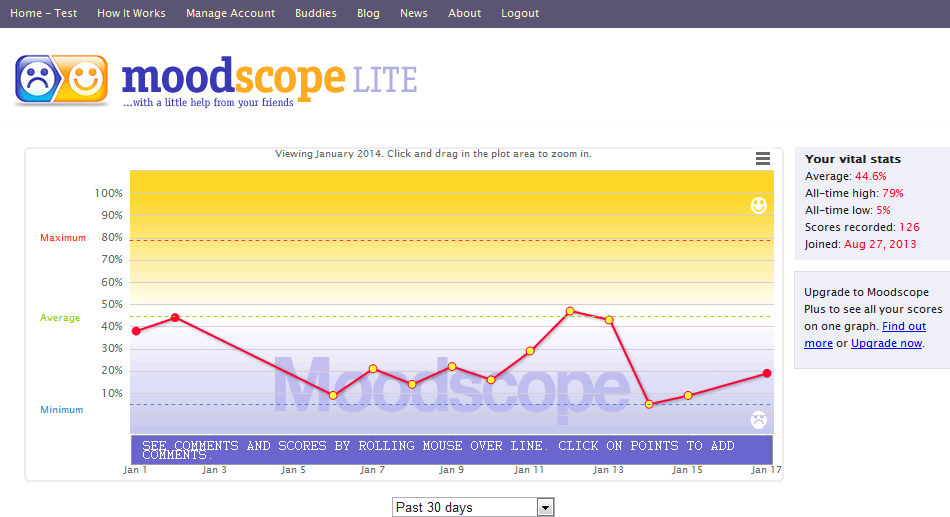
moodscope score
Moodscope is an online system which asks you to rate how you are feeling with 20 different emotional flashcards. For example – Jittery, Hostile, Strong, Alert – you rate 0 – very little or not at all, 1 – slightly, 2, quite a bit, 3 extremely. The system gives you a score out of 100% each day. You can see this logged on a chart (30 days/ month at a time on the free version) and make a few notes as to why you were feeling how you were, or what was going on at the time. Another really helpful feature is the ability to set people as “buddies” who will receive an email with your daily score. They don’t get any more of the data – but it can act as a trigger for them to perhaps give you a call and say, “Are you Ok?” if things have been looking bad for a while. And we all know social contact is good for our moods. There are paid variations which give you more information about your moods and triggers – so you could see which areas are contributing most to a high or low score and may need working on. But the free version is powerful enough for me. (I keep a separate log of my scores so I can see the ongoing graph. I could do the same with the individual scores if I were organised enough…)
You get an email reminder to complete your score every day – with an interesting blog from one of the team or a moodscope user.

Mappiness

20140117-223113.jpg
Mappiness is a study carried out by the London School of Economics, logging people’s mood in relation to where they were in the country, time of day, what were they doing, ambient noise levels etc. The app is downloadable from the App store (iphone/ipad only I think). This time, the app bleeps you a few times a day (you can say how often in the settings, and say when you don’t want to be disturbed, eg. after 10pm) – it registers three different characteristics: Happy / relaxed / awake. Then it asks who you are with, whether you are indoors / outdoors / in a vehicle; whether you are at home, work or elsewhere; and then it asks you what you are doing (from a list of possible activities). If you are outside, you can take a picture if your phone has that capability – and I think it also downloads any ambient noise. You can download your data for your own manipulation – but they also give you some helpful graphs / charts / figures. You can see your scores over the last seven days, your average weekly scores, where you are happier, who with, doing what. I can see from my list of activities that I am happier when gardening and singing than anything else. So why don’t I do these things more? Instead, I spend most of my time online or social media, which is down there in the things which I am miserable doing. Of course it’s a chicken and egg scenario. Perhaps I go online when I’m down – (or I’m just there most of the time anyway, and so more often when I’m down) or I sing when I’m happy. Rather than singing making me happy. But it’s interesting stuff.

Moodkit

20140117-223319.jpg
Another interesting app is Moodkit – which I admit I only use sporadically. Again, this allows you to log your mood score and take notes about it, but more interesting is the array of tools it gives you to try and improve your mood and challenge negative thinking. It allows you to say how much you have been doing various things, and then it suggests actions you could take to improve things. It also give you the option to select activities to work on specific areas, such as your productivity, social relationships, get more enjoyment out of life, do more physical activity- and several more. There’s a journal, and lots of other options to look through. Indeed writing this I am reminded I should use it more often!

To say it’s The Sun, it’s not very bright.

Corona of the Sun during a Solar Eclipse

Of course it can’t be merely coincidental. That only a week or two after the Almighty twitter storm that brewed up over Asda, tesco and amazon stocking Halloween costumes with insensitive, stigmatising names, The Sun decides to run a front page proclaiming “1200 killed by mental patients“. Ok. Maybe it’s progress. A few years ago it might have been “killed by nutters” or “psychos / schizos”. However I don’t think they’ve got the point of the campaigns to combat stigma around mental ill health.

What is the purpose of that headline? They misrepresent figures, omit to mention that homicide by people with mental health problems is lower than it has been in 7 years. What’s a mental patient? Are they seeking to make the public afraid of all those ordinary joes who tweeted their pictures as part of the excellent Mind response to the Halloween costume fiasco? Are they going to give us any more detail about the tragic circumstances around those deaths?

No one is saying that it never happens. It is a sad fact that sometimes it does. But unless I’m missing something – it is not only “mental patients” who kill people. Even if we take The Sun’s figures – 1200 in ten years. (Which maybe we shouldn’t) With a total number of homicides around 8089 for that period, you’d think it slightly more of a worthy story to say “6800 killed by people supposedly in their right minds”.

Who should you be more afraid of? You’re more likely to be killed by a drunk than someone with a mental health problem. And the stigma and fear that stories like this cause is one of the reasons that a “mental patient” is more likely to be a victim of violence than the cause of it. It’s also a major reason why people refuse to accept they are Ill, don’t seek help- and so if untreated their condition may worsen and the potential for a dangerous situation arising increases.

So again, I ask. What is that headline for? What is The Sun for? By alarming people, increasing stigma, they increase the risk they are bewailing. They hurt real people with complex problems that are more individual and difficult to deal with that can be expressed in the handy “mental patient” epithet.

The influence of our media is truly toxic these days. Has been for many many years. It is bad for our society and most certainly bad for our mental health and Wellbeing.

Roly poly roller coaster of doom

Fahrenheit Rollercoaster HersheyPark

Aye sheesh kebabs. It’s been a funny couple of weeks. Month. I have being honing my mood swing skills something chronic. Funny how the slightest thing sends me spinning into a spiral of despair. Take my last post for example. You may notice it’s been a while. And to be honest. I’m not that happy with it. But unfortunately my ipad didn’t want you to read the really, really good and pertinant version which I wrote on the train last week. Because it ate it. Just as I was posting it. Suddenly half of it was gone and I was left watching the memory of those clever words and phrases disappearing off into my mental distance.  I swore. A lot. And got very cross.

I don’t get cross much when I’m well. I’m a very mild mannered creature. Too mild mannered, it has been said. But when my mood slips I get very impatient and crotchety with everyone including myself.

However – it wasn’t really the losing of work or temper that was problematic here. It was that something hadn’t gone as I had expected it to. My plan was ruined. (Not that I’d strictly speaking made a plan to write and post the blog and be happy with it – but once I pressed “Publish” that was clearly what I expected it to do.)  If there is one thing which I have come to realise can pre-empt an almighty push on the Sarah Mood swing-o-meter, it’s a plan gone awry.  Silly little things. My husband announcing he’s getting the 10.20 bus when i thought we were going out at noon. Totally stupid and irrelevant. But the lack of an ordered, reliable, predictable plan makes me deeply uneasy. So I got off the train in an almighty huff – furious at Northern Rail, Apple, 3G, the Gods and the universe for their conspiracy against me. But no problem. It was a friday – usual plan, go for a drink in town, come up with an idea for food, either at home or out, and ease out the troubles of the week.  Except for whatever reason, we can’t agree on a plan. We drink more than I want to, I feel stupid for not being able to make a decision, I get upset, I feel stupid and guilty for getting upset over a stupid thing, and suddenly I am thinking of all the stupid things I have ever done and I’m hating myself and thinking my husband must hate this and he will leave me or something horrible will happen and everything will fall appart and it will all be my stupid fault and oh god why don’t I just die.  Or something like that. Ridiculous.  I know it is these days. I can see it for what it is. My illness going into overdrive at the slightest derailing trigger.  So I try to plan.

It’s always a sign I’m going into a bit of a manic phase, or a really wild up and downy phase. When I start planning. calendars of what we will do, or eat, on different nights of the week or month. Who will do what tidying. When will I write or work on some project or other.  I never stick to them. I usually meltdown shortly after. But I think it is my subconscious telling me – you really need structure. Structure, routine will keep you sane.  Unfortunately it doesn’t send a care package of fortitude or willpower with this insight and so I never manage to hold to my elaborate and beautifully drawn out plans.  Planning my wedding for the last two years I think kept me pretty well. I was able to be single minded about that. Had a goal which had to be acheived. Now that time has passed – I lack focus again, and the roller coaster returns.  My challenge is to try and find a new goal I can believe in and use it like a trellis to prop me up.

A rose by any other name – Diagnoses and Labels

During the last couple of Mental Health First Aid Courses I have done, the subject of diagnoses and labels has come up several times in one way or another. Different angles on the same topic perhaps:

– Do we clinicise what used to be normal human emotions?
– Do people cling to / identify with a diagnosis or label and can this hinder their recovery, or make them think things are worse than they really are?

There’s something about some of this type of comment that speaks to me of mistrust. Either of the psychiatric / mental health profession, or of people with these diagnoses, or of the pharmaceutical industry perhaps. Not of all of which mistrust might be unfair or misguided.

Are we clinicising normal human emotions? Are we saying that people have a disorder that can or should be treated, when once they would have been acknowledged with a shrug – as part of the normal range of human experience. On the one hand, I don’t like the way this sounds a bit like “we didn’t get depressed in my day”. On the other – it seems obvious. Our understanding of what the full, natural range of human emotion is – why it is the way it is, what influences it – is evolving all the time. There are clearly things which once were perhaps as being unalterable – which we now understand more and have the option of seeking to resolve. You don’t see many people dismissing arthritis and refusing pain medication, saying “in my day you just accepted the aches and pains of old age”. The key to whether this is a good or a bad thing is perhaps in the word “range” – in the phrase “range of human emotions”.

MHFA (and I) explores the concept of the mental health continuum. All things in life are experienced by degrees. Stress, anxiety, sadness – there is a point at which these are normal, necessary responses to life, with positive impacts on our survival. However, if they worsen, and begin to impact on our ability to carry out the necessary tasks which keep us alive and operating in society – then they become problematic, unpleasant, and it is not unreasonable for someone to wish to find a way to alleviate those symptoms and be able to live a normal and happy life again.

What is crucial – is that it is the person experiencing the symptoms who expresses when they have reached that level of unacceptability and also that they are involved in choosing how they wish to alleviate them. It should not be for the doctors alone, or the influence of the pharmaceutical industry to say – you experience symptom x, therefore you have y, which is treated by product z. It’s fine to know that product Z may be useful – but perhaps the patient doesn’t find symptom x so bad yet, or finds some other course of action helps them instead.

Do people cling to labels? Maybe. Diagnoses can be hard to come by. If you have struggled with difficult emotions or symptoms for years and been ignored, ridiculed, felt shame or self doubt over your stupid inability to just be like everyone else – then having a “professional”, and “expert” agree with you – and say, yes, there is something going on with you, you have depression, or anxiety, or whatever, and I’ll agree that your symptoms must be causing you tremendous difficulty. That can be such a massive relief. A vindication. And if it is also the only way you can access treatment, or adjustments in the workplace, or even just respect from others who’ve previously dismissed you as faking it – then you might cling to that diagnosis.

Diagnoses on the other hand can be millstones around our necks. Especially if they prove not to be the right ones. Once a label of depression or anxiety has been attached, prescriptions prescribed, it is incredibly difficult sometimes to go back to the doctor and say – hang on. This isn’t quite working. Either – the medication isn’t working, or there are other symptoms which are not being addressed. It seems almost impossible to get a referral to someone who has the time and inclination and specialism to go through everything that is going on with you and come up with an accurate diagnosis. It’s not easy – so many conditions have overlapping symptoms. Without living with a person all day every day it is difficult to know what they are like. A doctor has only the time you are with them and what you say to judge by. And that relies on you being well enough to go, to speak, having insight into your condition, having the strength to talk about it – and overcome the inclination that your depression will give you to not want to bother other people with it. It’s nothing. I’m overreacting, I’m not worth worrying about…  If you are concerned that what is going on with you, or your loved one, is more than “simple” depression or anxiety (not that I really think there is any such thing.) – it is hard work to get the right attention if you have a reluctant (or overworked) doctor. And also to get them to recognise that not everything that goes wrong with you is to do with your depression. Granted, some things may be connected. Stress and tension may well cause back ache and headache and stomach upset – but a diagnosis of a mental health condition does not make us suddenly immune to slipped disks, brain tumours or ulcers – so it is important our doctors make as much effort to rule these possible causes out as they would with a person with good mental health.

So a label can be a good, or a bad thing. Sometimes it can be very bad. If I take my diagnosis, go away and read up on it, try various treatments / therapies / self help methods – to better understand what’s going on in my head and why – to recognise my triggers and lessen my symptoms – then my diagnosis has been valuable to me. However, if I wear it like a badge, and an excuse. I am a depressive – I always have been, always will be… I have OCD, I have a phobia… Like having it means I can give up on trying to live a normal life. That’s bad. Presumably we seek help because it has become a problem for us. Just knowing its name doesn’t make it less of a problem, and we should use the power that naming and understanding a condition gives us to help lessen its interference in our lives.

To me – my diagnosis (which I don’t think is completely accurate, but I have an inkling what might be) – is a name for a bunch of symptoms that piss me off. If I can address and challenge, and conquer each of those symptoms separately – learn techniques to keep them under control – I won’t have cured myself of depression, but I will have drained it of its power over me. However I will also know that if I stop using those techniques, the depression will most probably creep back. That is what my diagnosis means to me I suppose. Always having to look over my shoulder no matter how well I feel, because as soon as I let my guard down it will come back. And I’m not very good at keeping it up.